Sustainable Mailer Box Design Tips for Online Fashion & Beauty Stores
Sustainable mailer box design sounds simple until you realize there's no one-size-fits-all answer. Brands swap in kraft paper, slap on an FSC logo, and call it done — only to face transit damage, customer complaints, or sustainability claims that don't hold up. The real solution? Treating sustainability as a design process, not a material swap.
There is no single "sustainable" mailer box. The right design depends on what you ship, how it travels, what your customer expects when they open it, and what "recyclable" actually means where they live. Fashion and beauty brands face very different constraints — and sustainable packaging must be designed around those constraints, not around a generic checklist.
Let me walk you through the decisions that actually move the needle — based on what I've seen across hundreds of mailer box orders for DTC fashion and beauty brands since 2016.
Why isn't switching to recycled material enough?
Most brands start here: "Just use recycled cardboard." It feels like the obvious move. But material alone is only one piece of the puzzle — and often not the biggest one.
Structural design choices — right-sizing, eliminating unnecessary inserts, and keeping to a single material — frequently reduce environmental impact more than upgrading paper grade1. A perfectly sized 250gsm box can outperform an oversized 350gsm recycled box in both material use and shipping emissions2.
Right-sizing matters more than you think
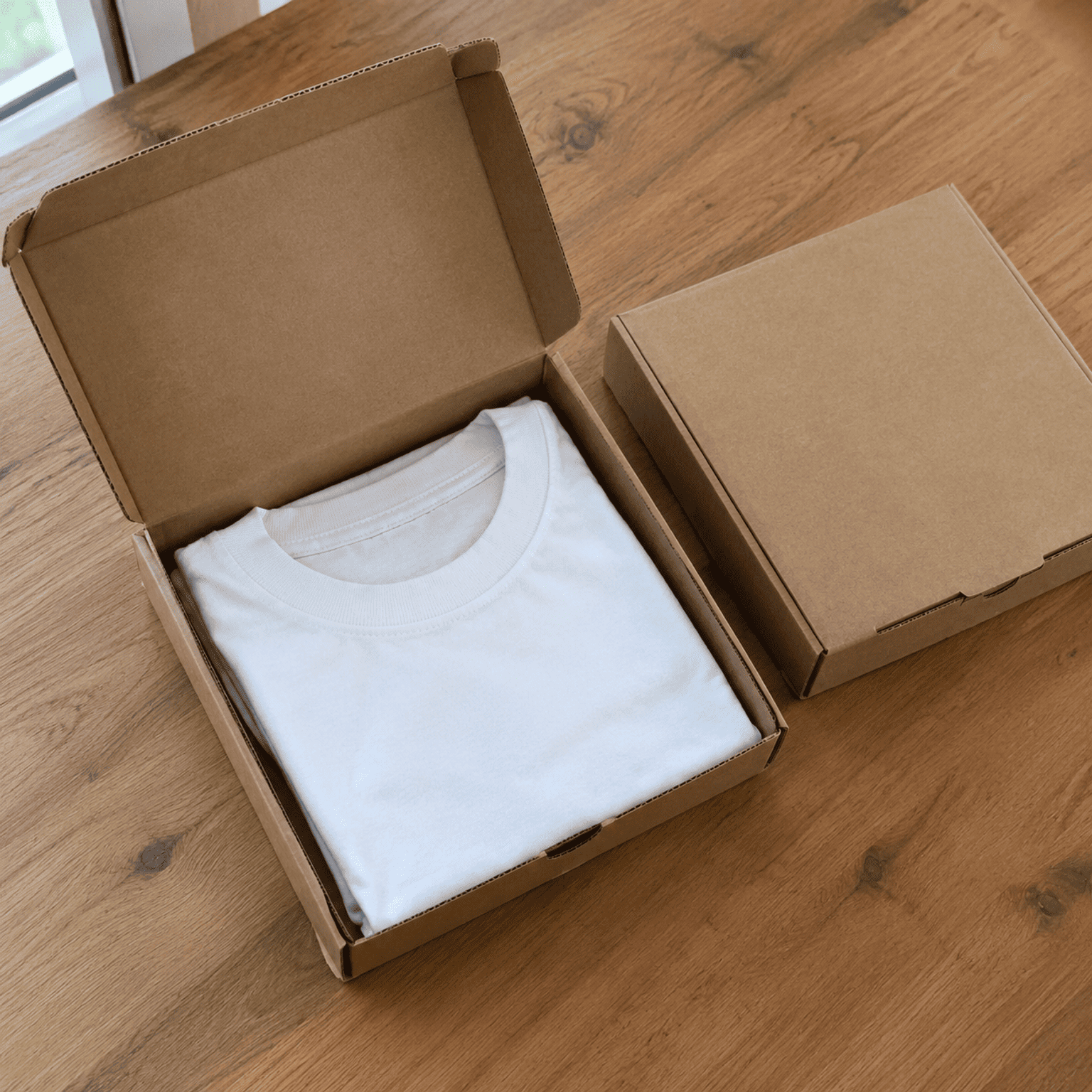
In our experience with fashion mailer orders, brands often default to two or three box sizes for their entire product range. That means a single t-shirt ships in the same box as a three-piece outfit, stuffed with void fill. Switching from three sizes to five can cut material use by 15–20% across a product line3 — without changing a single paper spec.
Single-material construction
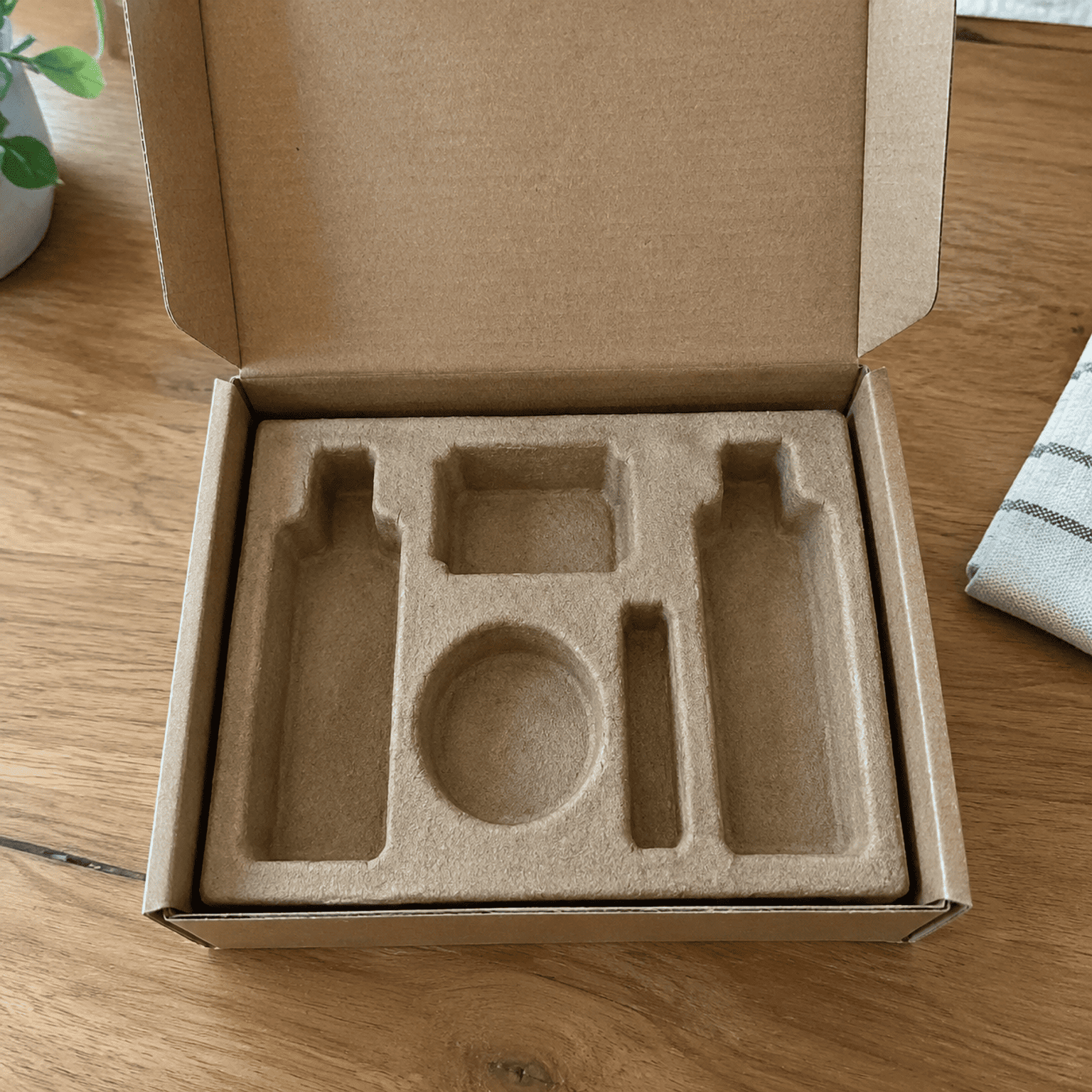
Every time you add a different material — a plastic window, a foam insert, a metallic laminate — you make the box harder to recycle. Brands shipping beauty kits often use molded pulp or corrugated dividers instead of foam inserts. It keeps everything one material stream, which is what curbside recycling programs actually need4.
| Design Decision | Impact on Sustainability | Common Mistake |
|---|---|---|
| Right-sizing | Reduces material + shipping weight | Using too few box sizes |
| Eliminating inserts | Simplifies recycling stream | Adding foam "just in case" |
| Single-material build | Curbside recyclable | Mixing paper with plastic laminate |
How do fashion and beauty mailer boxes differ?
This is where I see the most costly mistakes. Brands treat "mailer box" as one category, but fashion and beauty have opposite constraint profiles.
Fashion tolerates lighter walls (300–350gsm) and minimal interior protection. Beauty products — glass bottles, compacts, liquids — demand cushioning, tighter fits, and sometimes moisture barriers. A "sustainable" design that works great for apparel can destroy beauty products in transit.
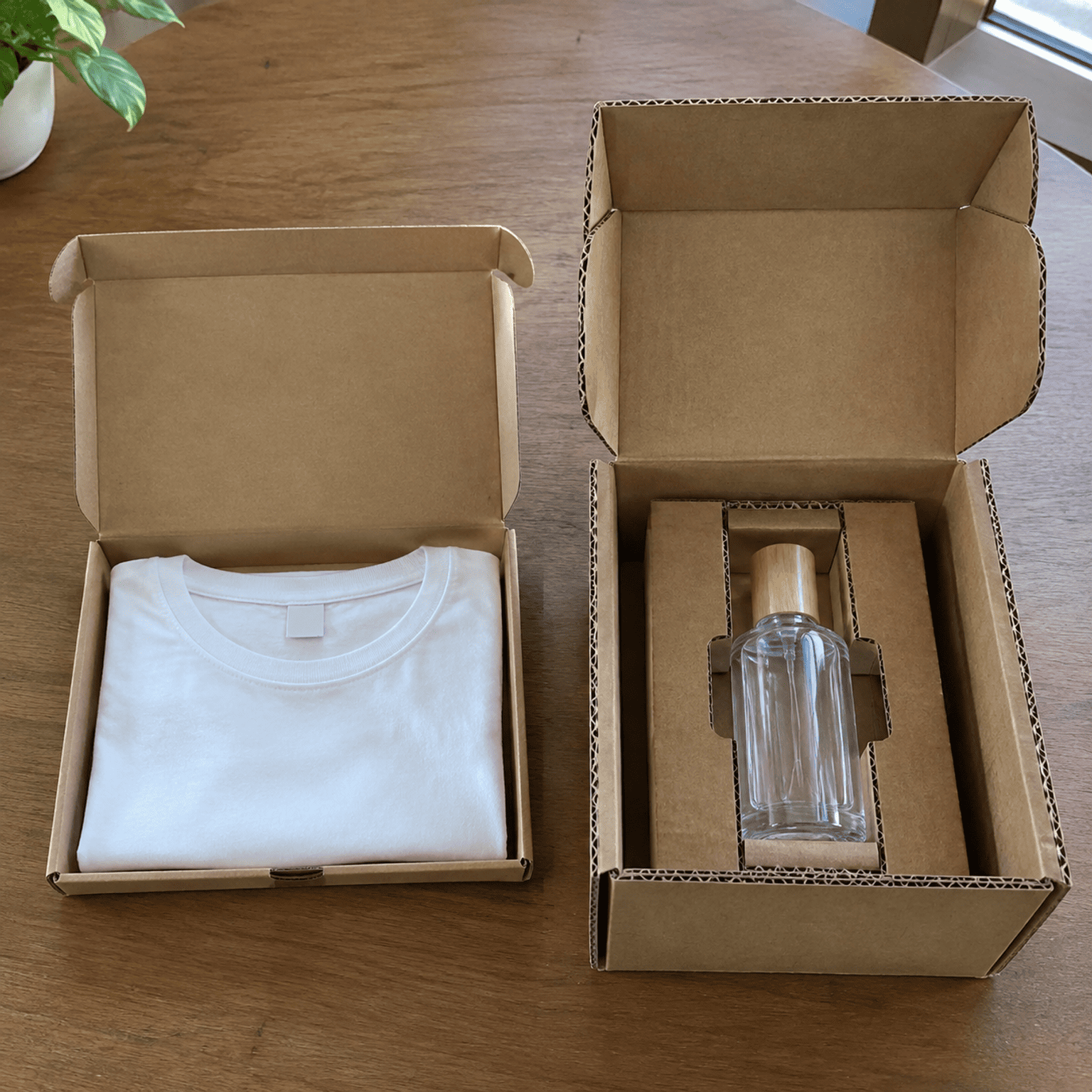
Fashion: lean and simple
For apparel and accessories, you can usually go lighter on board weight, skip interior inserts, and use a simple tuck-end closure. A 300gsm single-wall corrugated E-flute mailer handles most fashion shipments just fine5. That means less material, lower shipping cost, and easy recyclability.
Beauty: protection is non-negotiable
Brands shipping glass serums or pressed powder compacts typically find that going too light causes real problems. We've seen brands request ultra-thin eco boxes, then come back after a wave of transit damage. The fix isn't abandoning sustainability — it's designing smarter:
- Snug-fit corrugated inserts instead of plastic bubble wrap
- B-flute or E/B double-wall for heavier glass items
- Water-based coatings instead of plastic lamination for light moisture resistance
The sustainable choice for beauty is rarely the thinnest box. It's the box designed so precisely that it doesn't need extra padding.
What do sustainability certifications actually cover?
Certifications like FSC, PEFC, and GRS are valuable — but they're not the whole story. I hold these certifications, so I can tell you exactly what they do and don't guarantee.
FSC and PEFC certify that fiber is responsibly sourced. GRS certifies recycled content. None of them certify your inks, adhesives, coatings, or whether the finished box is recyclable in your customer's city.6 Treat certifications as one layer of proof, not the complete answer.

What each cert covers
| Certification | What It Covers | What It Does NOT Cover |
|---|---|---|
| FSC | Responsible forest management, chain of custody | Inks, coatings, adhesives, end-of-life recyclability |
| PEFC | Sustainable forest management standards | Manufacturing processes, recyclability |
| GRS | Recycled content percentage, chain of custody | Non-recycled components, final product recyclability |
The destination-market problem
A box that's technically recyclable in one country may not be curbside-recyclable in another. Heavy ink coverage, UV coatings, or glued-in magnets can disqualify a box from recycling streams in the US, EU, or Australia7. Always verify recyclability rules for your primary markets — don't assume your supplier's local standards apply everywhere.
Here's the tension every fashion and beauty brand feels: competitors deliver a gorgeous reveal moment, and a plain brown box won't cut it. But heavy print finishes and glossy laminates hurt recyclability.
You can create a premium unboxing experience without sacrificing recyclability. Embossing, debossing, single-color designs, soy-based inks, and water-based coatings all deliver visual impact while keeping the box in a single recyclable material stream.
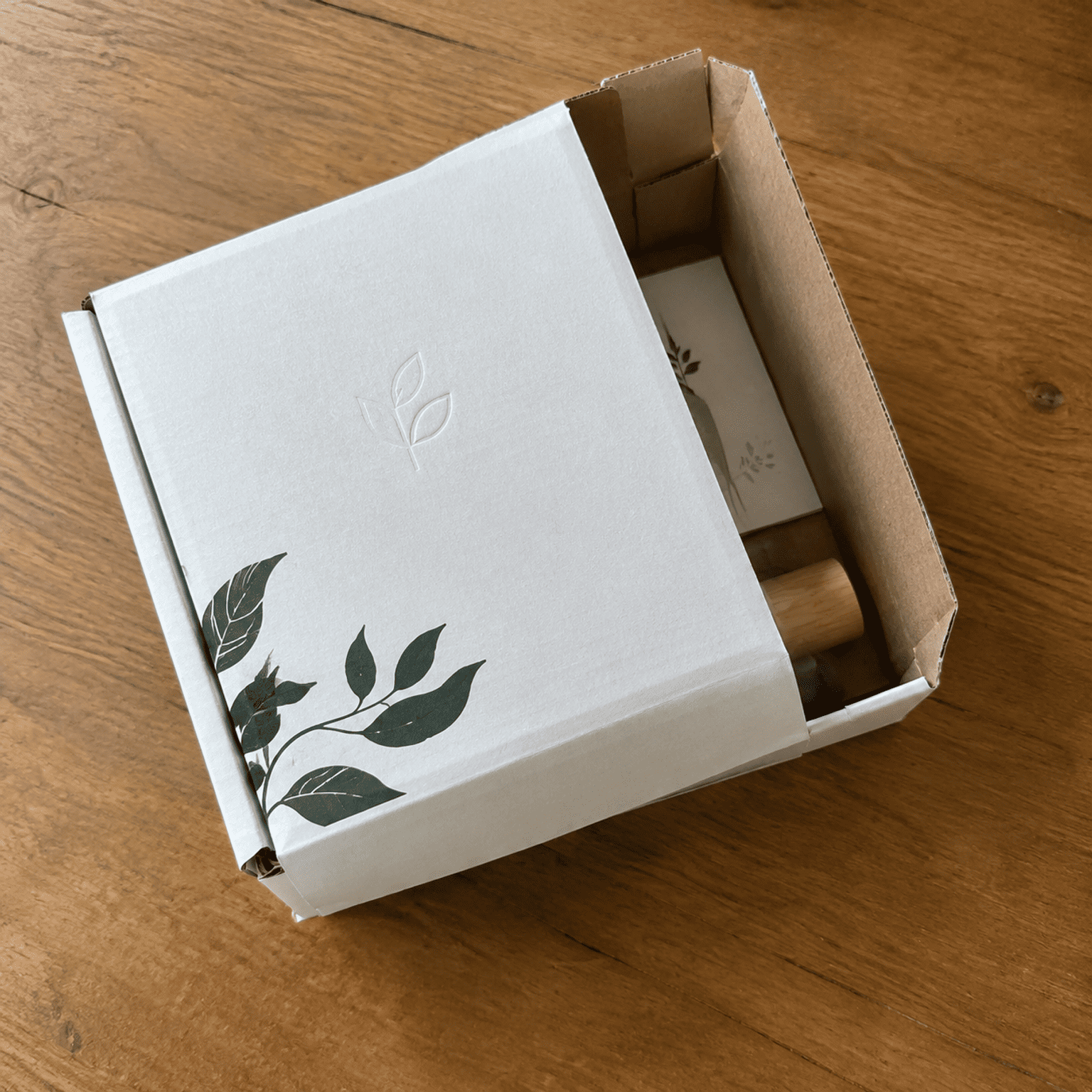
Practical options by scenario
- Minimal luxury look: Kraft E-flute + single-color print + blind embossed logo. Fully recyclable, striking shelf presence.
- Full-color brand story: White-lined corrugated + soy-based CMYK print + water-based matte coating. Recyclable in most US/EU streams.
- High-end beauty reveal: Rigid-feel corrugated + spot UV (small area) + tuck-in magnetic-free closure. Keeps recyclability high while feeling premium.
The key is to ask: does this finish serve the brand, or is it just habit? In our experience, brands that switch from full-sheet lamination to targeted embossing often get better customer feedback — and a genuinely recyclable box.
Frequently Asked Questions
Is kraft paper always more sustainable than white paperboard?
Not necessarily. Kraft avoids bleaching, but a white recycled board with water-based coating can be equally sustainable8. The real question is total material use, recyclability in your market, and whether the structure is right-sized.
Can I use soy-based inks on corrugated mailer boxes?
Yes. Soy-based inks work well on corrugated and are widely accepted in curbside recycling programs9. They're a practical swap for petroleum-based inks without sacrificing print quality.
How do I verify if my mailer box is recyclable in the US or EU?
Check with your local recycling authority or consult packaging compliance databases like How2Recycle (US) or OPRL (UK)10. Your supplier can confirm material composition, but destination-market rules require separate verification.
Do FSC-certified boxes cost significantly more?
In our experience, the premium is usually 5–10% over non-certified equivalents11. For most DTC brands, that cost is easily justified by the marketing value and buyer expectations around sustainability.
Conclusion
Sustainable mailer box design isn't about picking the "greenest" material off a list. It's about matching your box structure, material weight, print finishes, and certifications to the real constraints of your product category, shipping conditions, and customer expectations. Fashion and beauty brands face different trade-offs — and the best packaging decisions come from understanding those trade-offs clearly. If you're sourcing or redesigning your mailer boxes and want to talk through the options for your specific products and markets, I'm happy to share what we've learned across hundreds of projects. Reach out anytime.
"Recycling Basics and Benefits", https://www.epa.gov/recycle/recycling-basics-and-benefits. Lifecycle assessment literature consistently identifies source reduction — minimizing total material use through structural design — as a higher-priority environmental strategy than material substitution, in line with the EPA's waste management hierarchy (U.S. EPA, 'Reducing and Reusing Basics'). Evidence role: expert_consensus; source type: research. Supports: That source reduction and structural optimization in packaging design often deliver greater lifecycle environmental benefits than material substitution alone.. Scope note: LCA outcomes are product- and scenario-specific; the relative importance of design vs. material choice depends on the baseline packaging system being compared. ↩
"Impact analysis of packaging box composition on supply ...", https://dspace.mit.edu/bitstreams/800a5e02-09c2-4611-a864-2e9d5f8b40c5/download. Research on ecommerce packaging logistics has demonstrated that oversized boxes increase dimensional weight charges and per-shipment carbon emissions; studies by organizations such as the Sustainable Packaging Coalition have found that source reduction through right-sizing can deliver greater net environmental benefits than material substitution alone. Evidence role: general_support; source type: research. Supports: That reducing packaging dimensions and weight decreases both material consumption and transportation-related carbon emissions, and that these combined savings can outweigh the environmental benefits of using recycled content in an oversized package.. Scope note: The relative environmental performance of right-sized vs. oversized packaging depends on specific material grades, transport distances, and vehicle load factors; the claim is directionally supported but not universally quantified. ↩
"How To Right-Size Packaging to Reduce Shipping Costs - ISD", https://www.isddd.com/right-size-packaging-to-reduce-shipping-costs/. Industry research on packaging optimization has found that right-sizing shipping boxes to reduce void space can yield material savings of 20% or more, along with corresponding reductions in dimensional weight shipping costs (see, e.g., studies by the Sustainable Packaging Coalition on void fill reduction). Evidence role: statistic; source type: research. Supports: That right-sizing packaging to better fit product dimensions yields significant material and waste reductions in the range of 15–20% or more.. Scope note: Exact savings percentages vary by product mix, fulfillment volume, and baseline box size selection; the 15–20% figure is an operational estimate rather than a universally validated benchmark. ↩
"Recycling - DSNY", https://www.nyc.gov/site/dsny/collection/residents/recycling.page. The U.S. EPA and municipal recycling guidelines note that multi-material packaging (e.g., paper bonded to plastic film) is a common source of contamination in single-stream curbside recycling, often resulting in the entire item being landfilled rather than recycled. Evidence role: mechanism; source type: government. Supports: That multi-material packaging creates contamination issues in single-stream curbside recycling and that mono-material construction improves recyclability.. Scope note: Recycling infrastructure and accepted materials vary significantly by municipality; single-material construction improves but does not guarantee recyclability in all jurisdictions. ↩
"Overview of recent studies at IPST on corrugated board edge ...", https://bioresources.cnr.ncsu.edu/resources/overview-of-recent-studies-at-ipst-on-corrugated-board-edge-compression-strength-testing-methods-and-effects-of-interflute-buckling/. According to the Fibre Box Association and corrugated packaging engineering references, E-flute (approximately 1.5mm thickness) offers a smooth printing surface and sufficient compression strength for lightweight products, making it a standard choice for direct-to-consumer mailer boxes in apparel and similar categories. Evidence role: mechanism; source type: institution. Supports: That E-flute corrugated board provides adequate crush resistance and protection for lightweight, non-fragile items such as apparel while minimizing material thickness and weight.. Scope note: Adequate protection depends on specific product weight, shipping distance, and carrier handling conditions; 300gsm is a general guideline rather than a universally validated specification. ↩
"How the FSC System Works", https://fsc.org/en/how-the-fsc-system-works. According to the Forest Stewardship Council's chain-of-custody standard (FSC-STD-40-004), certification tracks the origin and processing of forest-based materials through the supply chain but does not assess or certify the recyclability of the finished product, nor the environmental profile of added components such as inks or adhesives. Evidence role: definition; source type: institution. Supports: That FSC chain-of-custody certification covers forest fiber sourcing and traceability but does not extend to non-fiber components such as inks, adhesives, or coatings, nor to end-of-life recyclability.. Scope note: Each certification program periodically updates its scope and requirements; practitioners should consult the latest versions of FSC, PEFC, and GRS standards directly. ↩
"Food packaging from recycled papers: chemical ... - PMC", https://pmc.ncbi.nlm.nih.gov/articles/PMC9576889/. The Association of Plastic Recyclers and paper recycling industry guidance note that non-fiber contaminants — including UV-cured coatings, metallic foils, and embedded magnets — can disrupt pulping processes and may cause otherwise recyclable paper packaging to be screened out at materials recovery facilities. Evidence role: general_support; source type: institution. Supports: That non-paper components such as UV coatings, heavy metallic inks, and magnetic closures can interfere with paper recycling processes and may cause packaging to be rejected from curbside recycling streams.. Scope note: Specific thresholds for rejection vary by facility and region; some advanced recycling operations can handle limited amounts of these contaminants. ↩
"Comparative life cycle assessment of paper and cardboard ...", https://www.sciencedirect.com/science/article/pii/S0048969726004870. Lifecycle assessment studies comparing bleached and unbleached paperboard have found that the environmental advantage of unbleached kraft is not absolute; recycled fiber content, manufacturing energy sources, and coating chemistry all significantly influence the overall environmental profile of the finished product. Evidence role: general_support; source type: research. Supports: That the environmental impact difference between unbleached kraft and white recycled paperboard is not straightforward and depends on multiple lifecycle factors including energy use, water consumption, and recycled content.. Scope note: LCA results are highly sensitive to system boundaries, geographic context, and allocation methods; no single study definitively establishes equivalence between these material options. ↩
"American Soybean Association", https://ustr.gov/countries-regions/japan-korea-apec/japan/us-japan-trade-agreement-negotiations/what-they-are-saying/american-soybean-association. Research supported by the American Soybean Association and printing industry bodies indicates that soy-based inks produce lower levels of volatile organic compounds than petroleum-based alternatives and are compatible with standard paper de-inking and recycling processes. Evidence role: general_support; source type: research. Supports: That soy-based inks are compatible with paper recycling processes and are widely used in corrugated packaging printing.. Scope note: Recyclability of printed packaging depends on total ink coverage and other factors beyond ink chemistry alone; soy-based inks are not inherently superior in all environmental metrics. ↩
"Guidelines for Use", https://how2recycle.info/wp-content/uploads/2025/01/How2Recycle_GuidelinesForUse_Abbreviated.pdf. How2Recycle, a project of the Sustainable Packaging Coalition, provides standardized recycling labels for packaging sold in the United States and Canada based on material assessments and access to recycling infrastructure; OPRL serves a similar function in the United Kingdom, with labels reflecting recyclability at the point of collection. Evidence role: definition; source type: institution. Supports: That How2Recycle (administered by the Sustainable Packaging Coalition in the US) and OPRL (On-Pack Recycling Label in the UK) are established labeling programs that evaluate and communicate the recyclability of packaging to consumers based on material composition and local recycling infrastructure.. Scope note: Both programs rely on self-reported material data from brand owners and periodic infrastructure assessments; labels reflect general recyclability rather than guaranteed acceptance at every local facility. ↩
"FSC-Certified Packaging Market Size & Trends 2026-2035", https://www.towardspackaging.com/insights/fsc-certified-packaging-market. Market analyses and industry surveys have reported that FSC-certified paper and packaging products typically command a price premium of 5–15% over comparable non-certified materials, depending on supply chain factors, order volume, and regional availability. Evidence role: statistic; source type: research. Supports: That FSC-certified paper and board products typically carry a modest price premium over non-certified equivalents, generally in the single-digit percentage range.. Scope note: Price premiums fluctuate with market conditions, pulp prices, and supplier relationships; the 5–10% figure reflects a general range rather than a fixed industry standard. ↩