
Eco-Friendly Packaging Certifications Explained for DTC Brand Owners
Eco-friendly packaging certifications can feel overwhelming when you're launching a new product line or switching suppliers. You see logos like FSC, PEFC, GRS, OEKO-TEX — and they all seem to promise the same thing. But picking the wrong one wastes money, and misusing one creates real compliance risk.
Here's the short answer: eco-friendly packaging certifications are not interchangeable. Each one covers different materials, meets different market requirements, and comes with specific rules about logo usage. DTC brand owners should choose certifications based on market regulations, retailer requirements, and consumer expectations — in that order — not just personal preference.
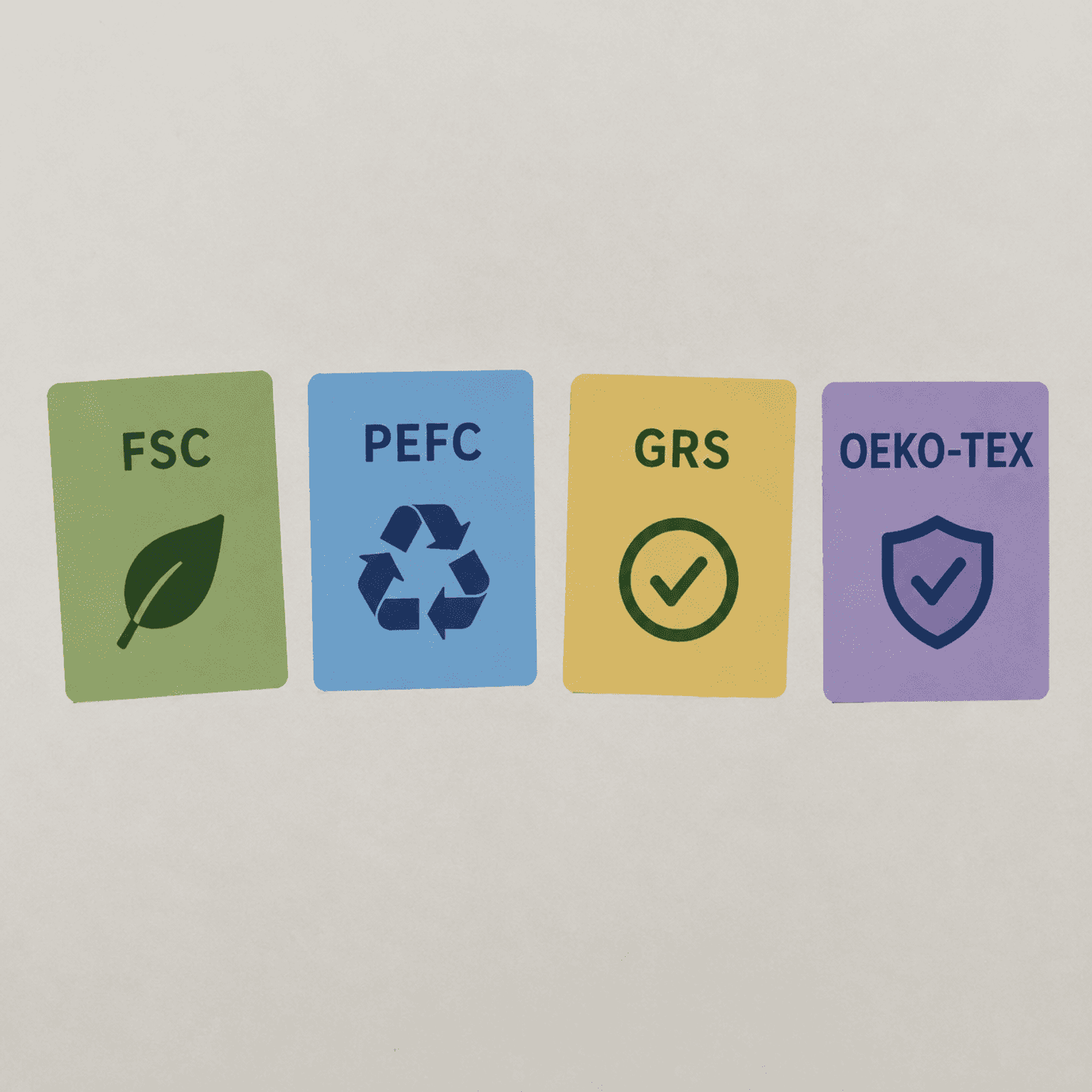
Before we break down each certification, let's clear up one thing that trips up almost every brand owner I talk to.
Does "Recyclable Material" Mean "Certified Packaging"?
No. This is the single biggest misunderstanding I encounter. A brand owner will tell me, "We're using kraft paper, so our packaging is eco-friendly, right?" Kraft paper is recyclable. But recyclable material and certified packaging are completely different things1.
A certification means an independent third party has verified the entire supply chain — from raw material sourcing through manufacturing2. Recyclable material just means the end product can be recycled. Without certification, you cannot legally use certification logos, and any "eco" claims you make on-pack sit on shaky ground.
Keep this distinction in mind as we go through each certification below.
What's the Difference Between FSC 100%, FSC Mix, and FSC Recycled?
This is the number-one question I hear from DTC brand owners. They know they want "FSC" but don't realize there are three distinct labels3 — each with different sourcing rules, costs, and marketing claims.
| FSC Label | What It Means | Typical Cost Premium | Best For |
|---|---|---|---|
| FSC 100% | 100% virgin fiber from FSC-certified forests | Highest (15–25%+)4 | Premium brands making bold sustainability claims |
| FSC Mix | Mix of FSC-certified, controlled, and/or recycled fiber | Moderate (8–15%) | Most DTC brands balancing cost and credibility |
| FSC Recycled | 100% recycled content, verified by FSC chain of custody | Moderate | Brands with a recycled-content story |
Ranges are directional based on our production experience at comparable MOQs. Actual pricing depends on material, volume, and specs.
FSC Mix is the sweet spot for most DTC brands. It's widely recognized by consumers, accepted by major retailers, and doesn't carry the premium of FSC 100%. If your brand story centers on recycled materials, FSC Recycled makes more sense. FSC 100% is worth it only when your market or retailer explicitly requires it.
Can I Just Print the FSC Logo on My Box?
No — and this catches people off guard. Buying packaging from an FSC-certified supplier does not automatically give you the right to print the FSC logo on your box.
Logo use requires a separate authorization process through FSC. Either your brand holds its own FSC chain-of-custody certificate, or your supplier applies for logo approval on your behalf under their certificate5. Every logo placement needs approval before going to print.
What happens if you skip this step?
- Audit risk: FSC conducts market surveillance6. Unauthorized logo use can trigger investigation.
- Retailer rejection: Major retailers verify logo authorization7. Non-compliant packaging gets pulled.
- Greenwashing liability: Regulators in the EU and US are tightening rules on environmental claims8. Unauthorized logos are low-hanging fruit for enforcement.
I'd recommend consulting a compliance specialist if you're uncertain about your market's greenwashing regulations. We can help with the logo authorization process on the packaging production side, but legal exposure is something your legal team should evaluate.
When Do You Need PEFC, GRS, or OEKO-TEX Instead?
Not every brand needs FSC. Here's a quick decision guide based on what I've seen work for our clients:
- PEFC — Recognized more in European markets. If your primary customers are in Northern Europe, some retailers prefer or accept PEFC alongside FSC. It covers sustainably managed forests, similar to FSC but with a different governance model.
- GRS (Global Recycled Standard)9 — Required when your packaging uses recycled polyester, recycled plastic, or recycled textile-based materials (like recycled cotton bags). If you sell poly mailers or non-woven bags with recycled content claims, GRS is the certification that backs it up.
- OEKO-TEX — Focused on harmful substance testing. Relevant for textile packaging — cotton bags, drawstring bags, ribbons — especially when selling in markets with strict chemical safety expectations.
A Simple Decision Framework
- Market regulation — Does your target country require specific certifications?
- Retailer requirement — Does your sales channel mandate a particular logo?
- Consumer expectation — What do your customers recognize and trust?
- Brand positioning — What story are you telling?
Work down this list in order. Don't start with brand positioning and work backwards — that's how you end up paying for certifications nobody asked for.
How Do I Verify a Supplier's Certification Is Real?
This takes five minutes and can save you from serious problems. Here's the process:
- Ask for the certificate document. Get the certificate number, scope, and expiry date.
- Check the issuing body's public database. FSC has info.fsc.org, PEFC and GRS have their own online directories.
- Confirm the scope covers your product type. A supplier might be FSC-certified for printing but not for packaging converting.
- Verify the expiry date. Certifications require annual renewal. An expired certificate is no certificate at all.
A common situation we see: a supplier claims FSC certification but their certificate expired six months ago, or covers a different product category. Always cross-reference.
Frequently Asked Questions
Do I need multiple certifications for one product?
Usually no. Most paper-based packaging needs only one forest certification (FSC or PEFC). You'd add GRS or OEKO-TEX only if your packaging includes recycled synthetic or textile components.
How long does it take to get certified packaging produced?
If your supplier already holds the certification, production timelines are similar to standard orders. The logo authorization step may add 1–2 weeks on the first order.
Are eco-friendly packaging certifications worth the cost for small DTC brands?
It depends on your sales channel. If you're selling into retailers that require it or targeting eco-conscious European consumers, yes. If you're selling DTC with no retailer mandates, weigh the cost premium against your brand story's ROI.
Conclusion
Eco-friendly packaging certifications are strategic decisions, not decoration. Match your certification to your market and channel requirements first. Understand the real differences between FSC 100%, FSC Mix, and FSC Recycled. Never print a certification logo without proper authorization. And always verify your supplier's certificates directly.
We hold FSC, PEFC, GRS, and OEKO-TEX certifications and have walked many DTC brand owners through this exact selection process. If you're unsure which certification fits your product line, reach out with your target market and sales channel details — I'm happy to help you figure out the right approach.
"Guides for the Use of Environmental Marketing Claims", https://www.ftc.gov/sites/default/files/attachments/press-releases/ftc-issues-revised-green-guides/greenguides.pdf. The US FTC Green Guides (16 CFR Part 260) distinguish between general environmental benefit claims and specific claims such as 'recyclable,' noting that recyclability claims refer to end-of-life material recovery, whereas third-party certification marks indicate independent verification of specific environmental standards across the supply chain. Evidence role: definition; source type: government. Supports: Regulatory frameworks distinguish between self-declared environmental claims (like 'recyclable') and third-party certified claims, with different evidentiary requirements for each.. Scope note: The FTC Green Guides are US-specific; equivalent distinctions exist under ISO 14021 (Type II environmental labels) and ISO 14024 (Type I eco-labels) but regulatory enforcement varies by jurisdiction. ↩
"Chain of Custody Certification", https://fsc.org/en/chain-of-custody. Chain-of-custody (CoC) certification, as defined by ISO 38200:2018 and implemented by systems such as FSC and PEFC, requires independent auditing of each entity in the supply chain to verify that certified materials are identified, segregated or controlled, and traceable from source to final product. Evidence role: definition; source type: research. Supports: Chain-of-custody certification in forest products and materials involves independent third-party auditing at each stage of the supply chain to verify that certified materials are tracked and segregated from non-certified materials.. Scope note: ISO 38200 provides a framework for chain-of-custody methods but does not itself constitute a sustainability certification; FSC and PEFC each implement CoC with additional environmental and social criteria. ↩
"What the FSC Labels Mean | Forest Stewardship Council", https://fsc.org/en/label. The Forest Stewardship Council defines three product labels: FSC 100% (products made entirely from FSC-certified forests), FSC Mix (products from a mix of FSC-certified, controlled, and/or recycled materials), and FSC Recycled (products made entirely from reclaimed material), as specified in FSC-STD-40-004 (Chain of Custody Certification). Evidence role: definition; source type: institution. Supports: FSC's labeling system comprises three on-product labels — FSC 100%, FSC Mix, and FSC Recycled — each with distinct sourcing and chain-of-custody requirements.. ↩
"Price premiums for certified wood products in Japan - PMC - NIH", https://pmc.ncbi.nlm.nih.gov/articles/PMC9211788/. Research on FSC price premiums has found that certified forest products can command premiums ranging from 5% to over 25% depending on product category, market, and supply chain position, though premiums for packaging-specific materials are less consistently documented (Overdevest & Rickenbach, 2006, Forest Policy and Economics). Evidence role: statistic; source type: research. Supports: FSC-certified virgin fiber products carry a measurable price premium over non-certified equivalents, with the magnitude varying by product type and market conditions.. Scope note: Most published premium studies focus on lumber and pulp markets rather than finished packaging; actual packaging premiums depend heavily on volume, supplier, and specification. ↩
"FSC® Trademark Use Guide", https://connect.fsc.org/sites/default/files/2022-08/FSC-Trademark-Use-Guide-for-Promotional-Licence-Holders_June2020.pdf. Under FSC-STD-50-001 (Requirements for use of the FSC trademarks by Certificate Holders), on-product FSC labels may only be applied by or under the authorization of a valid chain-of-custody certificate holder; non-certified brand owners may arrange for their certified supplier to apply for trademark approval on their behalf. Evidence role: mechanism; source type: institution. Supports: FSC trademark use on products requires chain-of-custody certification, with specific provisions for how non-certified entities can display FSC labels through their certified suppliers.. Scope note: FSC's trademark policies are periodically updated; specific procedures may vary by region and certifying body. ↩
"Intellectual Property Enforcement", https://www.state.gov/intellectual-property-enforcement. FSC's Global Market Surveillance Programme monitors the marketplace for unauthorized use of FSC trademarks and initiates corrective actions, including legal proceedings, against entities that misuse FSC labels without valid chain-of-custody certification (FSC, 'Protecting the FSC Label'). Evidence role: mechanism; source type: institution. Supports: FSC operates a trademark assurance program that monitors and investigates unauthorized use of FSC trademarks on products and marketing materials.. Scope note: Details of enforcement frequency and outcomes are not always publicly disclosed. ↩
"Retail & Ecommerce | Forest Stewardship Council", https://fsc.org/en/businesses/retail-ecommerce. Major retailers such as Walmart, Target, and Amazon have published sustainable packaging guidelines that include requirements for verifiable third-party certifications; Walmart's Project Gigaton and Target's Target Zero initiatives both reference certified sustainable sourcing as supplier expectations. Evidence role: case_reference; source type: other. Supports: Large retailers increasingly include sustainability certification verification in their supplier compliance programs.. Scope note: Specific enforcement mechanisms and the frequency of packaging rejection for logo non-compliance are not widely documented in public sources. ↩
"Green Guides", https://www.ftc.gov/news-events/topics/truth-advertising/green-guides. The European Commission's proposed Directive on Green Claims (2023/0085) would require companies to substantiate environmental claims with verified evidence before use in marketing, while the US Federal Trade Commission has announced a review of its Green Guides to address evolving environmental marketing practices. Evidence role: general_support; source type: government. Supports: The EU has proposed the Green Claims Directive (2023) requiring substantiation of environmental claims, and the US FTC has signaled updates to its Green Guides governing eco-marketing.. Scope note: The EU directive is proposed legislation and not yet enacted; FTC Green Guides updates are under review and final rules may differ from proposals. ↩
"Global Recycled Standard (GRS)", https://textileexchange.org/knowledge-center/materials/global-recycled-standard-grs/. The Global Recycled Standard (GRS), managed by Textile Exchange, sets requirements for third-party verification of recycled content, chain of custody, social and environmental practices, and chemical restrictions in products containing recycled materials (Textile Exchange, 'Global Recycled Standard 4.0'). Evidence role: definition; source type: institution. Supports: GRS, administered by Textile Exchange, is an international standard that verifies recycled content in products and tracks recycled materials through the supply chain.. Scope note: GRS originated in the textile industry; its application to rigid packaging materials is less established than for textile and flexible packaging. ↩