How to Choose the Right Eco-Friendly Packaging for Your E-Commerce Products
Choosing the right eco-friendly packaging for your e-commerce products sounds simple — until you realize "eco-friendly" means completely different things depending on what you sell, where you sell it, and who you're selling to. Pick the wrong option, and you waste money, confuse customers, or even risk compliance issues.
The right eco-friendly packaging isn't about grabbing the greenest-looking material. It's a decision that depends on your product type, target market regulations, sales channel requirements, and cost structure. A kraft box isn't automatically "eco," and an FSC label doesn't cover every concern. Start with your specific scenario, then work backward to the material.

Let me walk you through the framework I use every day when helping brands navigate this decision — so you can avoid the most common and costly mistakes.
Why Does "Eco-Friendly" Mean Different Things to Different Buyers?
When a DTC skincare brand asks me for eco-friendly packaging, and then an Amazon FBA seller in Germany asks the same thing, they almost never need the same solution. Yet both say the exact same words.
The problem is that "eco-friendly" has become a catch-all term. It can mean recyclable, compostable, biodegradable, made from recycled content, or simply "looks natural." These are not the same thing.
Here's a quick distinction every buyer should memorize:
| Term | What It Actually Means | Practical Reality |
|---|---|---|
| Recyclable | Can be processed into new material through existing recycling streams | Only works if your customer's local infrastructure actually accepts it |
| Compostable | Breaks down in industrial composting facilities within a set timeframe | If it hits a landfill, it doesn't compost — it just sits there1 |
| Biodegradable | Will eventually break down in natural conditions (no guaranteed timeframe) | Often misleading; almost anything is "biodegradable" given enough centuries2 |
I've seen buyers spend extra on compostable poly mailers for a US market where most customers have zero access to industrial composting3. That's not eco — that's just more expensive trash. Always match the end-of-life pathway to what's realistic in your target market.
Which Certification Actually Matters for Your Packaging Type?
A lot of buyers treat certifications like interchangeable trust badges. They're not. Each one covers a specific scope, and using the wrong one can actually hurt your credibility.
Here's how I break it down:
- FSC / PEFC — These certify chain-of-custody for paper and wood fibre. If you're ordering paper boxes, paper bags, hang tags, or wrapping paper, these are the certifications that matter. FSC is more widely recognized in North America and Europe; PEFC is strong in certain European markets4.
- GRS (Global Recycled Standard) — This certifies recycled content in your material. Relevant for poly mailers, recycled cotton bags, or any product claiming recycled input.
- OEKO-TEX — This tests for harmful substances in textiles. It matters for cotton bags, drawstring bags, and ribbon — not for paper boxes.
Using an FSC logo on a cotton bag? That makes no sense. Claiming GRS on a virgin-paper box? That's misleading. Match the certification to the material, and always verify the certificate is current. I always tell buyers: ask your supplier for the certificate number and check it yourself. It takes two minutes.
How Do You Match Eco Packaging to Your Specific Scenario?
This is where most generic advice falls apart. Instead of comparing materials in a vacuum, think in terms of product × market × channel.
Scenario 1: DTC Brand Shipping Direct to US Consumers
Your customer unboxes at home. They care about the experience and whether they can recycle the packaging curbside. Stick with FSC-certified paper-based packaging and minimize mixed materials (e.g., don't laminate paper with plastic film — it kills recyclability5). A clean, mono-material paper box is both brandable and curbside-recyclable in most US municipalities.
Scenario 2: Distributor Supplying Big-Box Retail in North America
Retailers like Walmart and Target increasingly have supplier sustainability scorecards. They want documentation — not just a green look. You'll need verified certifications, and your packaging may need to meet specific recyclability or recycled-content thresholds. Start with the retailer's published requirements before choosing any material.
Scenario 3: Amazon FBA Seller Targeting the EU
EU regulations on packaging waste are tightening fast6. Germany's VerpackG requires registration7; France has AGEC rules on eco-claims8. "Biodegradable" claims without certification can land you in legal trouble. For poly mailers, consider GRS-certified recycled PE. For boxes, FSC-certified corrugated works well. Confirm specifics with your compliance team.
The pattern: don't start with "what material is greenest?" Start with "what does my market accept, my channel require, and my customer expect?"
Does Eco Packaging Always Cost More?
Honestly? Sometimes yes, sometimes no. It depends on what you're switching from and what you're switching to.
Cost goes up when you move to specialty materials (like compostable films) or request low MOQs on certified stock. Cost goes down when you lighten material weight, simplify structure, or remove unnecessary components like plastic windows or excess inserts.
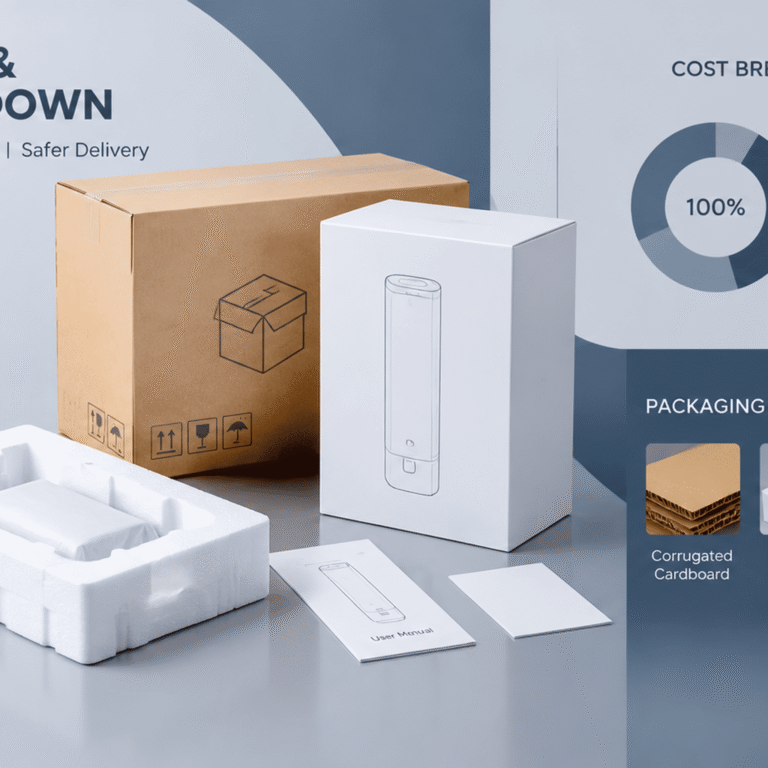
I've helped brands reduce packaging cost by switching from a rigid box with foam insert to a lighter FSC-certified folding carton with a paper-pulp tray. Less material, lower shipping weight, genuinely more sustainable — and cheaper.
The key cost levers to discuss with your supplier:
- Material weight and thickness — lighter often means cheaper and greener
- Print method — soy-based inks on uncoated stock vs. heavy UV coating9
- MOQ flexibility — certified materials sometimes require higher minimums
- Structure simplification — fewer components, fewer production steps
Frequently Asked Questions
Is kraft paper packaging automatically eco-friendly?
Not necessarily. Unbleached kraft looks natural, but without FSC or PEFC certification, you can't verify sustainable sourcing. And if it's laminated with plastic film, it may not be recyclable. The appearance of sustainability and actual sustainability are two different things.
Can I use the same eco packaging for all my markets?
I wouldn't recommend it. Recycling infrastructure, regulations, and consumer expectations differ significantly between the US, EU, and Australia10. What's recyclable in one market may not be in another. Build your packaging spec around your primary market first.
How do I verify a supplier's eco certifications are real?
Ask for the certificate number and the certifying body's name. Then check it directly on that body's public database (e.g., FSC's certificate search tool at info.fsc.org). A trustworthy supplier will share this without hesitation.
Conclusion
Choosing the right eco-friendly packaging is not about picking the greenest-sounding material. It's about aligning your packaging with your product needs, market regulations, channel requirements, and realistic end-of-life pathways — all while keeping cost under control. Start with your scenario, verify certifications against their actual scope, and be honest about what "eco" really means for your customer. If you're navigating this decision for the first time or switching from conventional materials, I'd encourage you to bring these questions to your packaging supplier early in the process. The right conversation upfront saves costly revisions later.
"Compost Emissions – More Than Just a Matter of Smell", https://csanr.wsu.edu/compost-emissions-more-than-just-a-matter-of-smell/. Research on the fate of compostable plastics in landfills indicates that the anaerobic, low-moisture conditions typical of modern landfills inhibit the aerobic microbial activity required for composting, resulting in negligible degradation over observed timeframes. Evidence role: mechanism; source type: research. Supports: Compostable materials require specific conditions (heat, moisture, microbial activity) found in industrial composting facilities and do not meaningfully decompose in anaerobic landfill environments.. Scope note: Degradation rates may vary by specific material composition and landfill conditions; some newer landfill designs may differ. ↩
"Environmental Claims: Summary of the Green Guides", https://www.ftc.gov/business-guidance/resources/environmental-claims-summary-green-guides. The US Federal Trade Commission's Green Guides (16 CFR Part 260) advise that unqualified 'biodegradable' claims should only be made if the entire product or package will completely decompose within one year after customary disposal, noting that such claims can deceive consumers when materials end up in landfills or other conditions where degradation does not occur within a reasonably short period. Evidence role: definition; source type: government. Supports: Regulatory bodies have recognized that unqualified 'biodegradable' claims can be misleading because they lack a defined timeframe or environmental conditions for decomposition.. Scope note: The FTC Green Guides are guidance documents rather than binding regulations, though they inform enforcement actions against deceptive environmental marketing claims. ↩
"U.S. Recycling Infrastructure Assessment and State Data ...", https://www.epa.gov/smm/us-recycling-infrastructure-assessment-and-state-data-collection-reports. According to EPA and industry surveys, municipal composting programs that accept compostable packaging remain available to only a small fraction of US households, with most curbside programs limited to yard waste and food scraps rather than certified compostable packaging materials. Evidence role: statistic; source type: government. Supports: The majority of US households do not have convenient access to industrial composting facilities that accept compostable packaging.. Scope note: Access varies significantly by region, and the number of composting programs is growing; exact percentages depend on how 'access' is defined. ↩
"Programme for the Endorsement of Forest Certification", https://en.wikipedia.org/wiki/Programme_for_the_Endorsement_of_Forest_Certification. Global forest certification data indicate that PEFC endorses the largest total certified forest area worldwide, with particularly strong adoption in European countries with national certification schemes, while FSC has cultivated broader consumer-facing brand recognition, especially in North American and Western European retail markets. Evidence role: general_support; source type: research. Supports: FSC and PEFC have different levels of market penetration and consumer recognition across regions, with PEFC certifying a larger total forest area globally but FSC often having stronger brand recognition among consumers.. Scope note: Market recognition is difficult to measure precisely and varies by industry segment; both certifications continue to expand their reach. ↩
"Contamination & Recycling FAQs | Sustainability at Princeton", https://sustain.princeton.edu/take-action/contamination-recycling-faqs. According to recycling industry guidance, paper products laminated or coated with plastic films are typically rejected from paper recycling streams because the plastic component contaminates the pulping process, making the combined material effectively non-recyclable through standard municipal recycling infrastructure. Evidence role: mechanism; source type: institution. Supports: Paper packaging laminated with plastic film is generally not accepted in standard paper recycling streams because the plastic layer cannot be separated during conventional pulping processes.. Scope note: Some specialized recycling facilities can process certain laminated materials, and emerging technologies may expand recyclability of mixed-material packaging in the future. ↩
"Packaging and packaging waste directive", https://en.wikipedia.org/wiki/Packaging_and_packaging_waste_directive. The European Commission proposed the Packaging and Packaging Waste Regulation (PPWR) in November 2022 to replace the existing 1994 Directive, introducing binding targets for packaging reduction, mandatory recycled content thresholds, and restrictions on certain packaging formats, representing a significant tightening of EU packaging waste requirements. Evidence role: general_support; source type: government. Supports: The EU is actively revising and strengthening its packaging waste framework through the proposed Packaging and Packaging Waste Regulation (PPWR).. Scope note: The PPWR was still undergoing legislative negotiation as of 2024, and final requirements may differ from the original Commission proposal. ↩
"The German Packaging Act", https://www.gruener-punkt.de/en/packaging-licensing/packaging-act. Under Germany's Verpackungsgesetz (VerpackG), effective since January 2019, any entity that first places packaged goods on the German market must register in the LUCID database maintained by the Zentrale Stelle Verpackungsregister and contract with an approved dual system for packaging take-back and recycling. Evidence role: general_support; source type: government. Supports: Germany's Verpackungsgesetz (VerpackG) requires producers and distributors who place packaged goods on the German market to register with the LUCID packaging register and participate in a dual system for packaging recovery.. ↩
"Anti-Waste and Circular Economy Law", https://en.wikipedia.org/wiki/Anti-Waste_and_Circular_Economy_Law. France's loi AGEC, enacted in February 2020, introduced provisions prohibiting the use of the term 'biodegradable' on single-use packaging and products disposed of through household waste streams, as part of broader measures to combat greenwashing and promote circular economy practices. Evidence role: general_support; source type: government. Supports: France's loi AGEC (Anti-Gaspillage pour une Économie Circulaire) restricts certain environmental marketing claims on packaging, including the use of terms like 'biodegradable' on single-use products.. Scope note: The specific provisions and their enforcement timelines have been phased in over multiple years; the exact scope of restricted claims may evolve with implementing decrees. ↩
"Environmental Comparison of Soy to Petroleum Ink with ...", https://scholarworks.wmich.edu/cgi/viewcontent.cgi?article=1367&context=engineer-senior-theses. Studies on paper recycling processes indicate that soy-based inks, derived from renewable soybean oil, are more easily removed during de-inking than petroleum-based alternatives, while heavy UV coatings can impede fiber recovery by creating a non-water-soluble barrier on paper surfaces. Evidence role: mechanism; source type: research. Supports: Soy-based inks facilitate paper recycling more readily than UV coatings, which can create barriers in the de-inking and repulping process.. Scope note: The environmental advantage of soy-based inks depends on the full lifecycle assessment including agricultural inputs; UV coatings may be necessary for certain product protection requirements. ↩
"Plastic pollution is growing relentlessly as waste ...", https://www.oecd.org/en/about/news/press-releases/2022/02/plastic-pollution-is-growing-relentlessly-as-waste-management-and-recycling-fall-short.html. OECD data and comparative policy analyses show significant variation in municipal recycling rates, accepted packaging materials, and regulatory frameworks across countries; for example, EU member states operate under harmonized extended producer responsibility schemes, Australia has implemented the National Packaging Targets through APCO, and the US relies on a fragmented system of state and municipal programs with no unified federal packaging waste regulation. Evidence role: general_support; source type: institution. Supports: Recycling infrastructure, accepted materials, and packaging regulations differ substantially across major markets including the US, EU member states, and Australia.. Scope note: Conditions within each market also vary significantly at the sub-national level, particularly in the US and Australia where recycling programs are managed locally. ↩